Earthshot Prize 2026: Full Finalists List, Mumbai Date & Karan Johar to Host
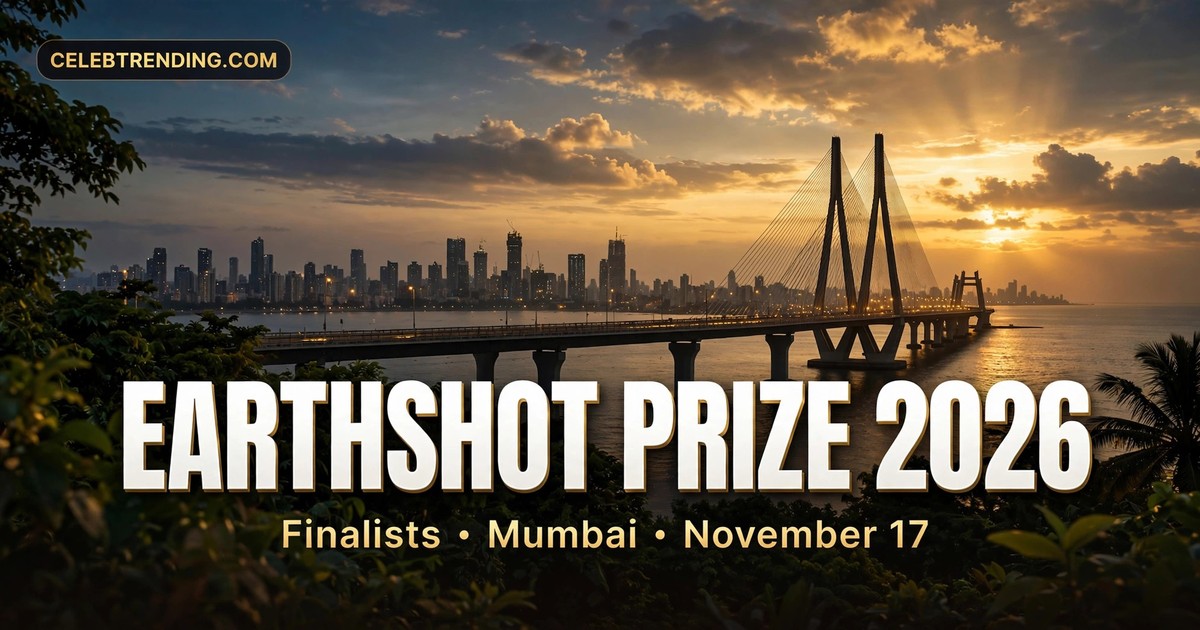
Earthshot Prize 2026 finally has a home in India. The sixth edition of Prince William's global environmental award will hold its Awards Night in Mumbai on November 17, 2026 — the first time the Prize has ever come to India — with filmmaker Karan Johar confirmed as host, the first Indian to take the role.
Fifteen finalists from across the globe are in the running, and five of them will walk away with £1 million each to scale their solutions. Here is everything confirmed so far: the date, the venue plan, the full finalists list, India's record-breaking presence, and how the winners get picked.
The Mumbai Date Is Locked
After editions in London, Boston, Singapore, Cape Town and Rio de Janeiro, the Earthshot Prize announced Mumbai as its sixth host city back in February 2026. The 2026 programme runs across two days — November 16 and 17 — with the Awards Night closing the event on the 17th.
The build-up is already underway. On October 13, Prince William played a friendly game of tennis-ball cricket on The Mall in London — Buckingham Palace in the background — alongside Sourav Ganguly, Ajinkya Rahane, Brian Lara, Joe Root and Harry Brook, as a curtain-raiser for the Mumbai ceremony. Rahane later wrote that he was looking forward to welcoming the Prize to his home city next month.
Karan Johar to Host — A First for India
The hosting news broke alongside the finalists announcement, and it is a genuine moment: Karan Johar becomes the first Indian to host the Earthshot Prize Awards Night. The announcement came via a video of Johar speaking with Prince William, shared across the official Prince and Princess of Wales social media handles.
"To be the first Indian to host The Earthshot Prize Awards Night is a moment of immense pride for me, and to do so in Mumbai makes it all the more meaningful," Johar said. He added that while cinema lets people imagine new worlds, the innovators recognised by Earthshot are working to build a better one. Additional presenters and performers are expected to be announced in the coming weeks.
Meet the 15 Finalists
The 2026 cohort was announced on September 17, selected from nearly 7,000 nominations across 169 countries. For the first time, the Prize applied the science of "positive tipping points" — solutions capable of triggering self-reinforcing environmental change — to its selection criteria. Here they are:
Protect and Restore Nature
Yellowstone to Yukon is leading one of the largest conservation collaborations in history, reconnecting a vast mountain landscape across Canada and the US so wildlife can move freely as it did for millennia. Australia's Indigenous Desert Alliance supports Indigenous communities and 70 ranger teams managing the world's largest Indigenous-led conservation corridor. And Bhutan — the Himalayan kingdom — shows how a small nation's forests can safeguard water security for an entire region, with environmental protection written into its constitution.
Fix Our Climate
India's Mahila Housing Trust is driving a women-led heat resilience model: affordable heat-reflecting roofs, community-led Heat Action Plans, and climate risk insurance for women on low incomes. Pula combines insurance and technology to shield smallholder farmers from the financial shock of droughts and floods. Denmark's Ørsted, the renewable energy company behind some of the world's largest offshore wind projects, is working to accelerate the global move away from fossil fuels.
And the Rest of the Field
Argentina's Satellites on Fire is an AI-powered wildfire detection platform spotting and tracking blazes across 21 countries — faster than NASA. Mahindra Last Mile Mobility, one of India's biggest three-wheeler manufacturers, has transformed its supply chain and now sells more electric three-wheelers than anyone else in the country. The Zero Emission Maritime Buyers Alliance (ZEMBA) is uniting global cargo owners behind binding commitments to zero-emission shipping.
Also in the running: the City of Barcelona, South Korea's Zero Waste Movement Network, the Niue Ocean Wide Trust, PFAS-Free France, the Philippines' Mother Earth Foundation, and Kenya's AirQo — air-quality monitoring built for the Global South.
India's Biggest Earthshot Moment Yet
This is worth saying plainly: no country has more Earthshot history than India. The country counts seven finalists including four winners across the Prize's six editions — the highest of any nation — and 2026 adds two more homegrown contenders in the Mahila Housing Trust and Mahindra Last Mile Mobility.
The Mumbai edition is backed at home, too: the Awards Night is sponsored by the Serum Institute of India. Between the host city, the host, the sponsor and the finalists, this is the most Indian the Earthshot Prize has ever felt — by design.
How the Winners Are Chosen
The 15 finalists now go before the Earthshot Prize Council, which includes Prince William alongside Queen Rania Al Abdullah, Cate Blanchett, Indra Nooyi, José Andrés, Christiana Figueres, Hindou Oumarou Ibrahim, Wanjira Mathai, Nemonte Nenquimo, Gisele Bündchen, Luisa Neubauer, Naoko Yamazaki and Dr Ngozi Okonjo-Iweala.
Five winners — one per category: Protect and Restore Nature, Clean Our Air, Revive Our Oceans, Build a Waste-Free World and Fix Our Climate — will each receive £1 million, plus mentorship, resources and access to the Prize's global network of businesses, investors and climate experts. The track record is serious: since 2020, the Prize's finalists have collectively avoided or captured more than 18 million tonnes of CO2e, protected or restored 58 million hectares of land and 85 million hectares of ocean, and improved air quality in regions home to 600 million people.
Why Mumbai Matters
Awards ceremonies move cities for a reason. Bringing the Earthshot Prize to Mumbai puts the world's attention on the country producing more of its finalists and winners than anywhere else — and on the solutions emerging from the Global South, which make up a significant share of this year's cohort. On November 17, five of those solutions get £1 million each and a global stage. The harder question — which of them tips from promising to planetary — starts the morning after.